
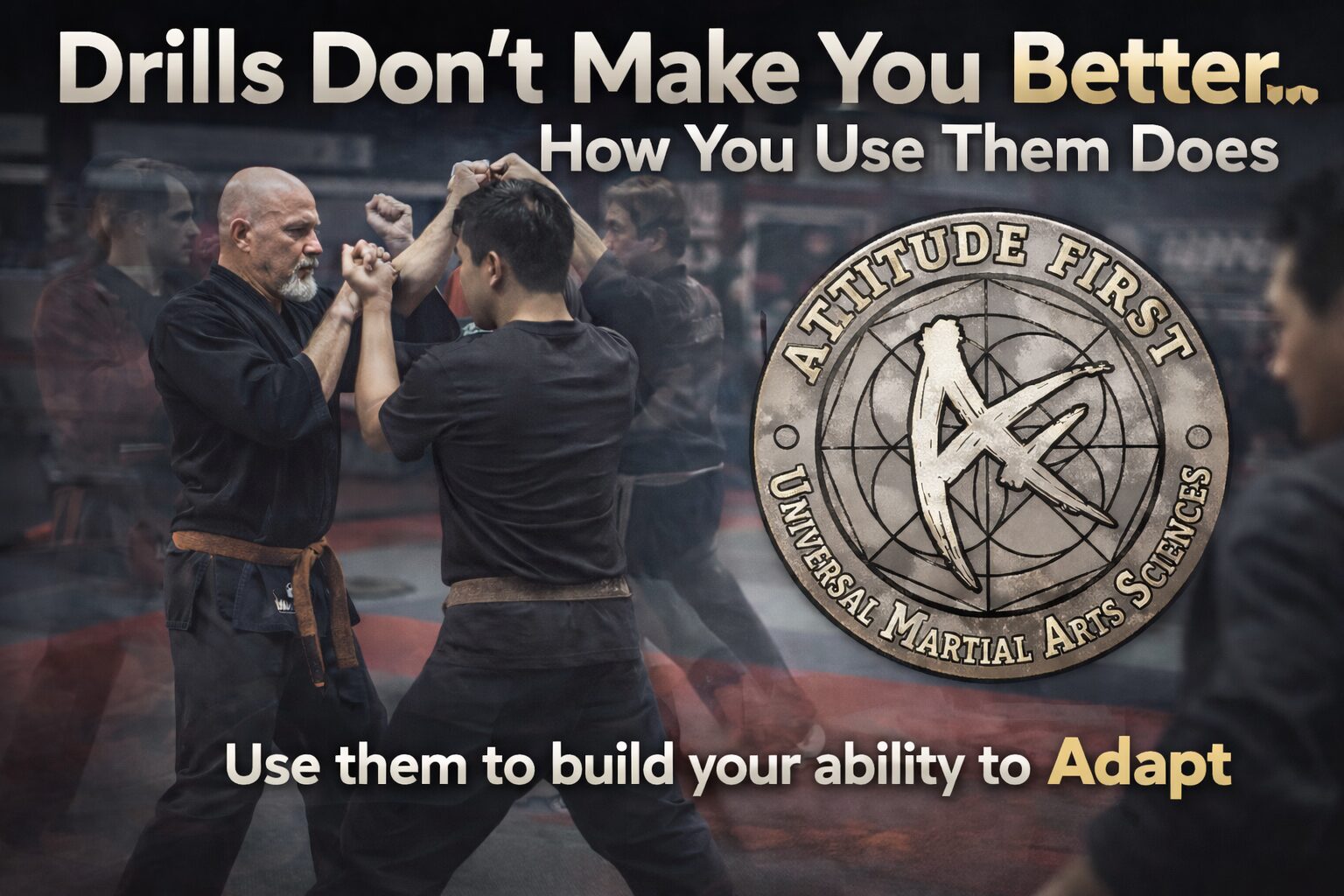
Drills don’t make you better.
They make you familiar.
And familiarity feels a lot like progress… right up until something changes and everything falls apart.
That’s the part people conveniently ignore.
The Drill Illusion
Drills are clean.
Predictable.
Repeatable.
That’s why people gravitate toward them.
- You know what’s coming.
- You know what to do.
- You can execute without hesitation.
It feels sharp. It feels efficient. It even looks impressive.
But it’s controlled. And the wrong understanding of control creates a false sense of certainty.
Because the moment timing shifts…
Distance changes…
Energy increases…
That “sharp” execution starts looking a lot less reliable.
Confidence built in a controlled environment is fragile if it’s never tested outside of it.
What Drills Are Actually For
Drills are not performance. They’re preparation.
They exist to:
- Build patterns
- Develop coordination
- Introduce timing
- Create a starting point
That’s it. They are the beginning of understanding… not the proof of it.
And here’s where things quietly go wrong for a lot of people:
They get good at the drill…
…and mistake that for being good at the skill.
One is rehearsal. The other is application.
Those are not the same thing, no matter how much we want them to be.
Our Perspective at Attitude First
This is where your training either matures… or stalls out.
At Attitude First, we don’t just look at what you’re doing. We look at what you’re learning to control.
Because every drill should be developing your ability to manage four things:
Yourself
Can you stay balanced, aware, and composed… even when the drill stops going your way?
Your Dimensions
Are you controlling distance, angles, positioning… or just standing where the drill told you to stand?
The Attack
Do you understand what’s actually being thrown at you… or are you just memorizing a response?
The Attacker
Can you read intent, adjust to pressure, and deal with variability… or do you need them to “feed” you correctly to succeed?
Most drills only train one of these at a time. Real improvement comes when you start connecting all four.
That’s where Logic shows up. That’s where Expression becomes necessary.
And that’s where things start getting uncomfortable… which is exactly where growth lives.
The Shift
Repeating a drill is easy.
Using a drill requires thought.
Instead of asking:
“How many reps did I get?”
Start asking:
“What did I change… and why did it work (or not)?”
Now take a simple drill and start breaking it on purpose:
- Change the timing
- Interrupt the rhythm
- Adjust the distance
- Increase or decrease resistance
- Alter the intent
Now it stops being a script. Now it becomes a conversation.
And conversations require awareness, decisions, and adaptation.
You know… the things you actually need.
Practical Takeaway
Take one drill you already know.
Run it three ways:
Clean and structured
Hit your positions. Understand the pattern.
Slightly unpredictable
Add small changes. Miss a beat. Adjust spacing.
Fully adaptive
Now your partner can change things, and you have to respond in real time.
No reset button. No perfect setup.
If your performance collapses the moment it stops being predictable…
That’s not failure. That’s information.
Use it.
Closing Thought
Drills don’t make you better.
They make you comfortable.
And comfort is useful… right up until it isn’t.
If your training never challenges your ability to adapt,
you’re not building skill…
you’re rehearsing a routine and hoping reality cooperates.
It won’t.
Might as well train like you know that.
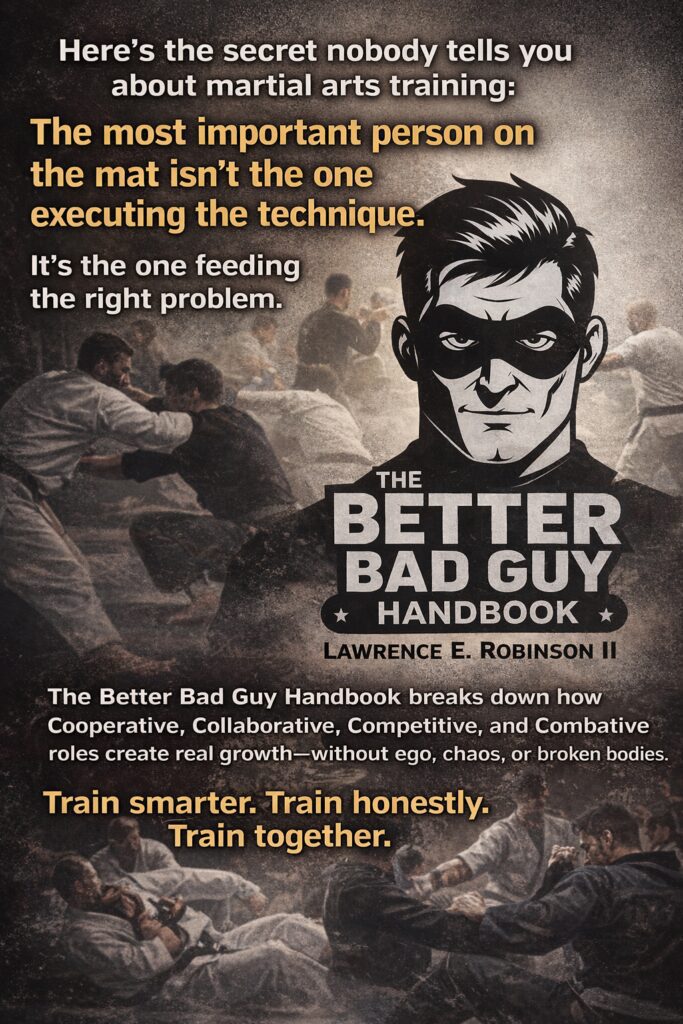
For a deeper dive in how this might work Check Out “The Better Bad Guy Handbook” by Lawrence E. Robinson II
For more information contact us at info@attitudefirst.com