
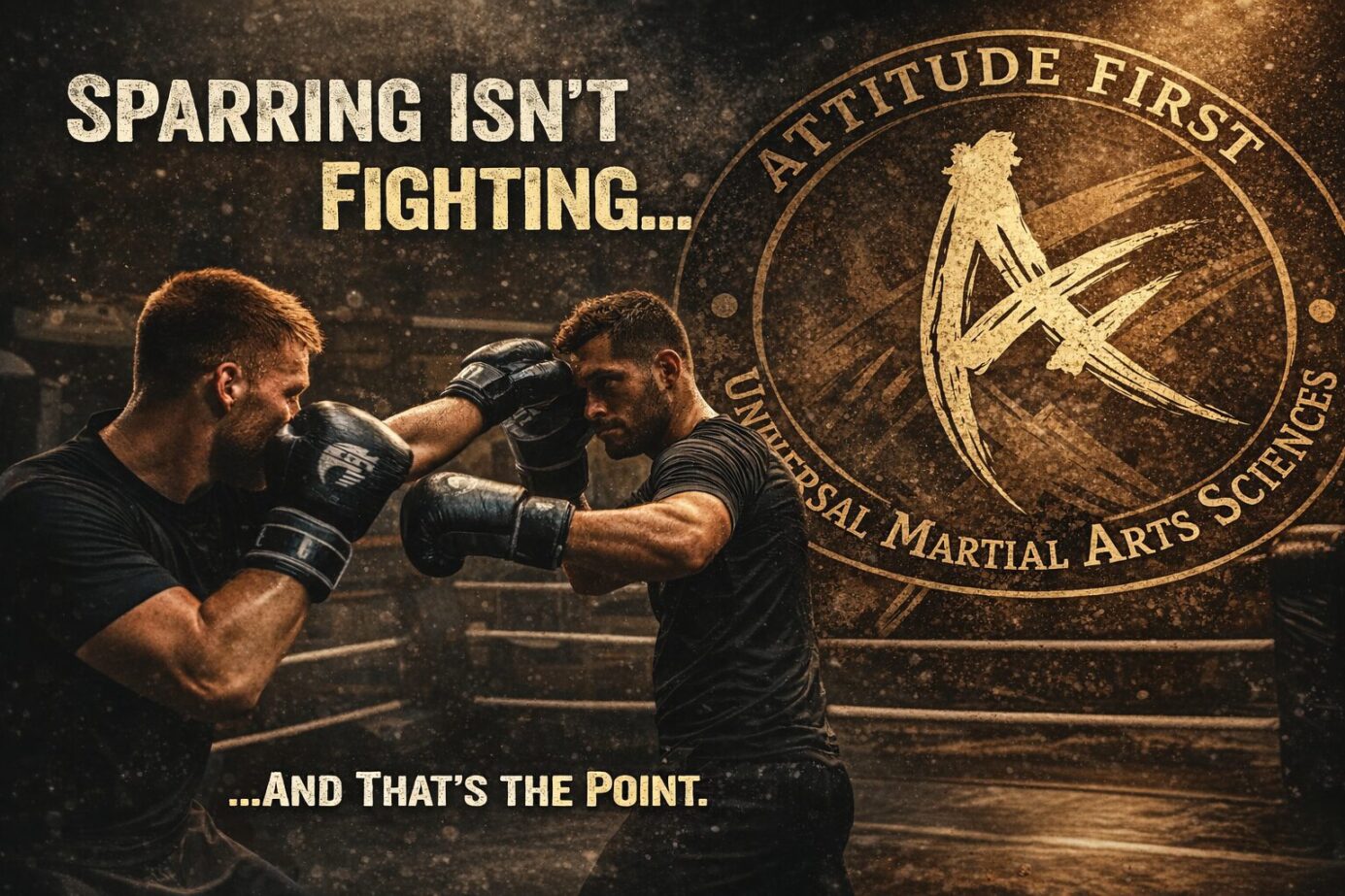
There’s a strange expectation in training that sparring should look like fighting.
More intensity.
More chaos.
More “realism.”
As if the closer it looks to a fight, the more valuable it becomes. That sounds logical. It’s also wrong.
Because sparring isn’t supposed to be fighting.
It’s supposed to prepare you for it. And those are not the same thing.
The Misunderstanding
When people say:
“That wouldn’t work in a real fight…”
What they often mean is:
“That didn’t look like a fight.”
But sparring isn’t there to prove what works. It’s there to develop your ability to make things work.
That’s a very different objective. Fighting is outcome-driven. Sparring is development-driven.
If you confuse the two, you start chasing the wrong things.
What Fighting Actually Is
Fighting is:
- Unpredictable
- Uncontrolled
- High consequence
There are no rounds.
No agreements.
No shared expectations.
No one is trying to “help you learn.”
They’re trying to win, escape, or overwhelm.
It’s messy.
And more importantly… it’s final.
You don’t get feedback mid-exchange.
You get results! Sometimes You won’t like the results!!
What Sparring Is Supposed to Be
Sparring, when done correctly, is:
Structured unpredictability.
Not chaos. Not choreography. Something in between.
It gives you:
- Timing without full consequence
- Resistance without complete risk
- Freedom without total breakdown
It’s where you explore:
- Distance
- Timing
- Adaptation
- Decision-making
Not just whether something works…
But why it works, when it works, and how to adjust when it doesn’t.
The Problem With “Winning” Sparring
If your goal in sparring is to win…
You’ve already lost the point.
Because now you’ll:
- Avoid risks
- Rely on strengths
- Hide weaknesses
You’ll become efficient…
At staying exactly where you are!
And nothing kills development faster than protecting your ego under the disguise of performance.
If you always look good in sparring, your training is lying to you.
Our Perspective at Attitude First
This is where your framework matters.
Sparring is when we use a SMILE and it allows us to test it:
- Structure – Can you maintain position under pressure?
- Movement – Can you adjust without freezing or overcommitting?
- Intention – Are you choosing actions or reacting blindly?
- Logic – Do your decisions match the situation?
- Expression – Can you deliver appropriately based on energy and context?
Sparring is not about proving your technique. It’s about exposing your process. And refining it.
The Missing Piece: Freestyle
This is where most training either levels up… or falls apart.
Sparring often becomes either:
- Too controlled → looks good, teaches little
- Too chaotic → feels real, teaches less
Freestyle lives in the space between.
- Not bound by strict rules.
- Not driven by winning.
- Driven by exploration and experimentation.
This is where:
- You try things you’re not good at yet
- You adjust in real time
- You discover what actually transfers
It’s less about “Can I beat you?”
And more about:
“Can I understand what’s happening… while it’s happening?”
That’s a completely different skill.
And it’s the one that actually carries over.
A Hard Truth
You don’t rise to the level of your sparring.
You default to the level of your understanding. See ( “You don’t rise…” )
If sparring is shallow…
Your application will be shallow.
If sparring is intentional…
Your responses will be adaptable.
The Shift
Stop asking:
“Does this work in a fight?”
Start asking:
“What is this teaching me that will work under pressure?”
Now sparring becomes:
- A lab instead of a test
- A process instead of a performance
- A tool instead of a scoreboard
Practical Takeaway
Next time you spar, change the objective.
Don’t try to win the round.
Try to:
- Notice timing instead of forcing it
- Adjust distance instead of chasing it
- Manage energy instead of matching it
And most importantly…
Let yourself be uncomfortable enough to learn.
Final Thought
If sparring looks like fighting, something is off.
If sparring builds your ability to handle fighting…
Now you’re training.
(Coming Soon…)
This idea is just the surface.
There’s a deeper layer to this:
How exploration, experimentation, and adaptability actually shape performance in real time.
Not through memorization.
Not through repetition alone.
But through how you learn to move, decide, and adjust under pressure.
That’s where Excellence in Freestyle lives. This book is being written by our very own Mr. Robinson and should be published in 2026.
For more information contact us at info@attitudefirst.com